
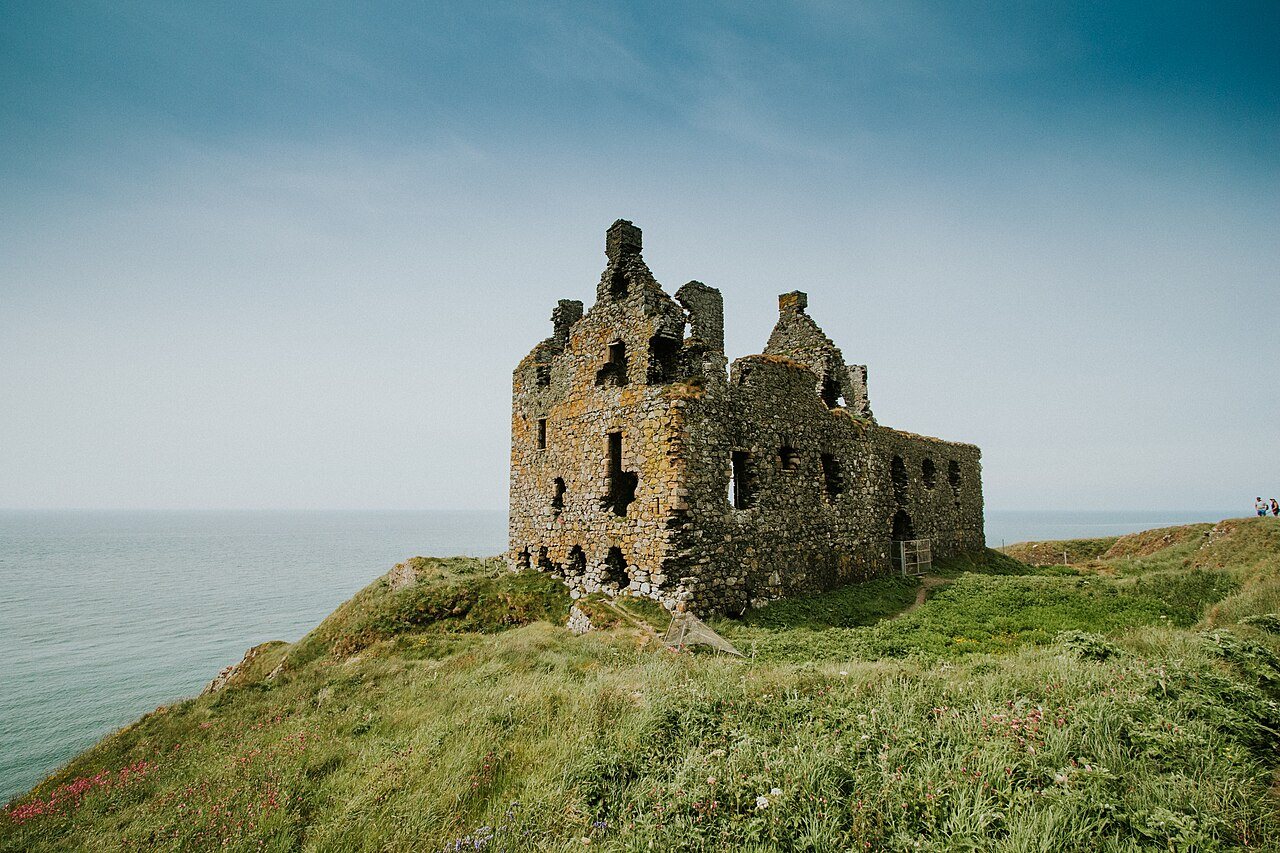
Dunskey Castle stands on a coastal promontory south of Portpatrick. Its outline against the sea is striking, but the most useful visit begins with the surrounding land: the approach, the narrowness of the headland and the relationship between stone walls and cliffs. You can explore these questions from outside the ruin.
Let the landscape explain the position
Look at a map before setting out and locate the castle relative to Portpatrick's harbour. The official coast-path description places it on the route towards Port Logan. That full stage is a substantial walking commitment, so decide on an appropriate shorter outing rather than following a distant destination by default.
From the established path, consider where the sea limits an approach and where land connects the promontory to the mainland. These observations help you understand the choice of site. They do not, by themselves, establish exactly how every historical defence worked or how the coastline looked in a particular century.
Read the surviving outline carefully
Study the changes in wall height and the shapes of openings that you can see without leaving the route. A roofless building can expose relationships that were hidden when it was occupied. Yet missing floors, weathering and later damage also remove evidence, so avoid inventing room functions from a single view.
Historic Environment Scotland identifies Dunskey Castle as a scheduled monument. For deeper research, use the official record and associated historic material. Keep documented information separate from local legends about ghosts or secret passages. A story may be part of the place's folklore without being evidence of a physical feature.
A simple drawing can be helpful: mark only the walls and openings visible from your position, then add questions for later research. Label an uncertain feature as uncertain instead of converting a guess into a fact in your travel notes.
Keep the photograph within the walking plan
DG Trails states that there is no access to the castle. Treat the visit as an exterior view and respect barriers or notices. The coastal approach includes steep and uneven ground; check the route and weather before leaving the village, and turn back if conditions make the chosen stretch unsuitable.
Use your camera's framing or a modest zoom to bring the ruin into the picture. Do not move towards a cliff edge or climb masonry for a clearer angle. Choose the return point before becoming absorbed in photographs, and keep enough time and energy for the walk back to Portpatrick.
A couple of practical questions
Can visitors go inside Dunskey Castle?
The official coast-path information says there is no access to the castle. Plan to see its exterior from the established route and follow any local restrictions.
Must I walk all the way to Port Logan to see it?
No. The castle is one feature on a much longer route. Choose a suitable shorter outing from Portpatrick after checking the precise path, ascent, conditions and return arrangements.

.jpg)
.jpg)