
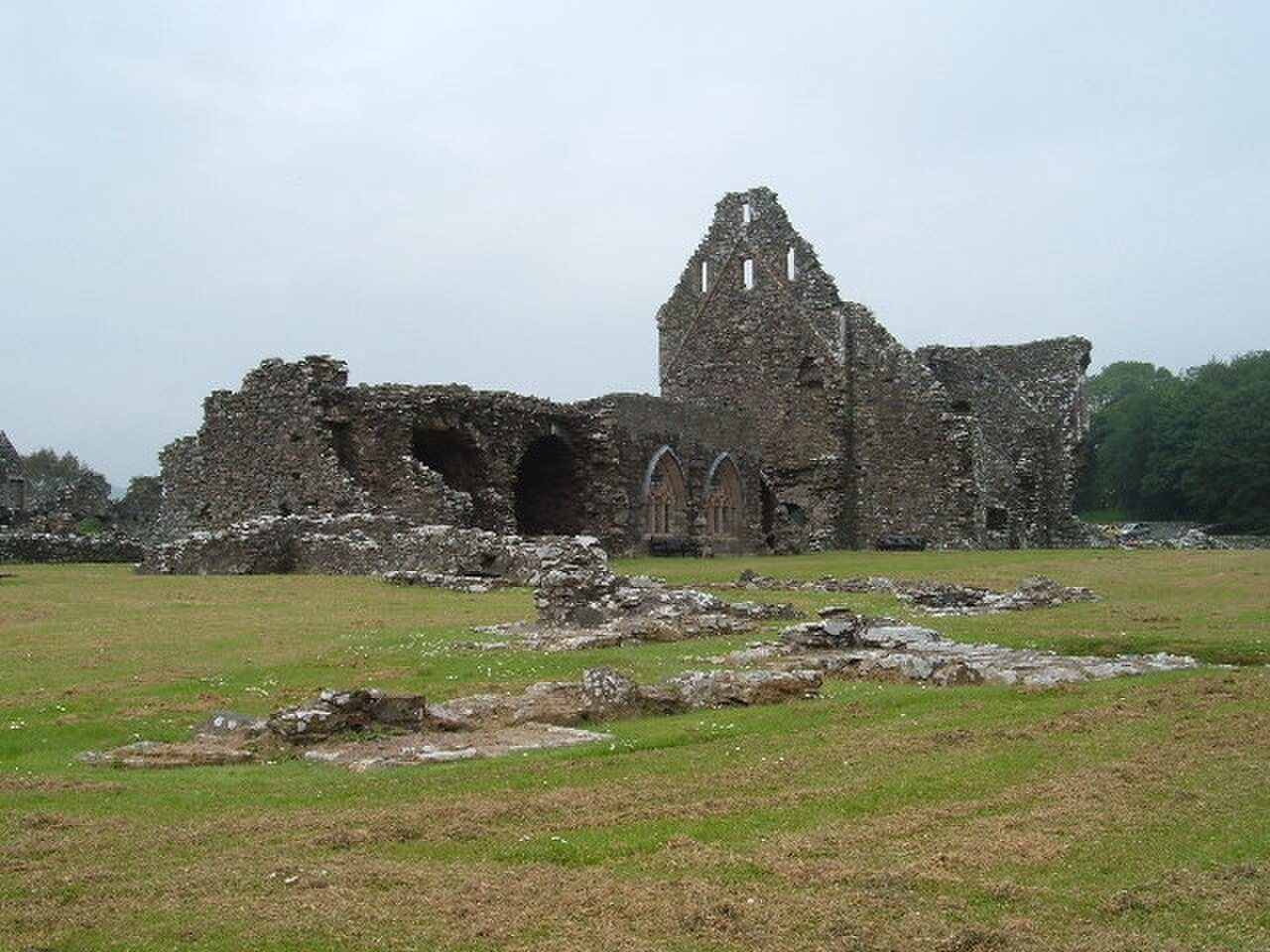
A ruined monastery can look like a collection of disconnected stone fragments until you have a plan in mind. At Glenluce Abbey, begin with the relationship between worship, communal life and the surrounding valley. The remains belong to a long-lived institution, and the building's changing condition is part of what visitors need to understand.
Find the plan before following every wall
Use the interpretation available for your visit to orient yourself. Identify the church and its relationship to the other monastic spaces before trying to name individual rooms. A wall's surviving height can be misleading: the tallest fragment is not necessarily the place that was most important in daily life.
Keep a distinction between a reconstructed plan and what is actually visible. A diagram may show a complete building whose foundations or walls survive only in part. Match one corner or doorway to the plan, then work outward from that point.
Give one architectural fragment your attention
Historic Environment Scotland highlights the south transept as a surviving example of thirteenth-century Cistercian architecture. If that area is available during your visit, study its scale and the arrangement of the masonry. Looking closely at one identifiable fragment is often more rewarding than attempting to picture every missing roof at once.
Think about a community over time
The site's account describes about four centuries of monastic life and the last monks' experience around the Reformation. Avoid compressing those centuries into a single routine. Buildings, people and religious circumstances changed, and a later feature may sit beside evidence from an earlier phase.
Ask how water, food, work and movement would fit into a community based here. Use the museum and interpretation to check answers rather than assuming every low wall marks a particular workshop. For a family visit, compare the size of a communal space with a familiar room at home; this creates a concrete question without requiring a complete lesson in medieval terminology.
Plan around conservation and the weather
Check the current HES visitor information before travelling. Conservation work can restrict parts of the abbey, and a photograph showing a visitor in a particular area does not confirm access today. Ask about the exact route if uneven ground or steps matter to someone in your group.
Allow for an outdoor visit even when you also hope to see indoor interpretation. Keep clear of restricted masonry, leave stones in place and use the designated visitor route. A carefully chosen view of the available remains can still explain the site's layout when some sections are closed.
A couple of practical questions
Is the abbey a complete medieval building?
It is a ruined monastic site with surviving architectural fragments. A site plan helps connect those remains, while interpretation can explain spaces that no longer stand to their original height.
Will every part of the abbey be open?
Check the current HES information and local notices. Conservation restrictions can change what visitors can approach, so plan around the available areas rather than an older photograph or itinerary.

.jpg)
.jpg)