
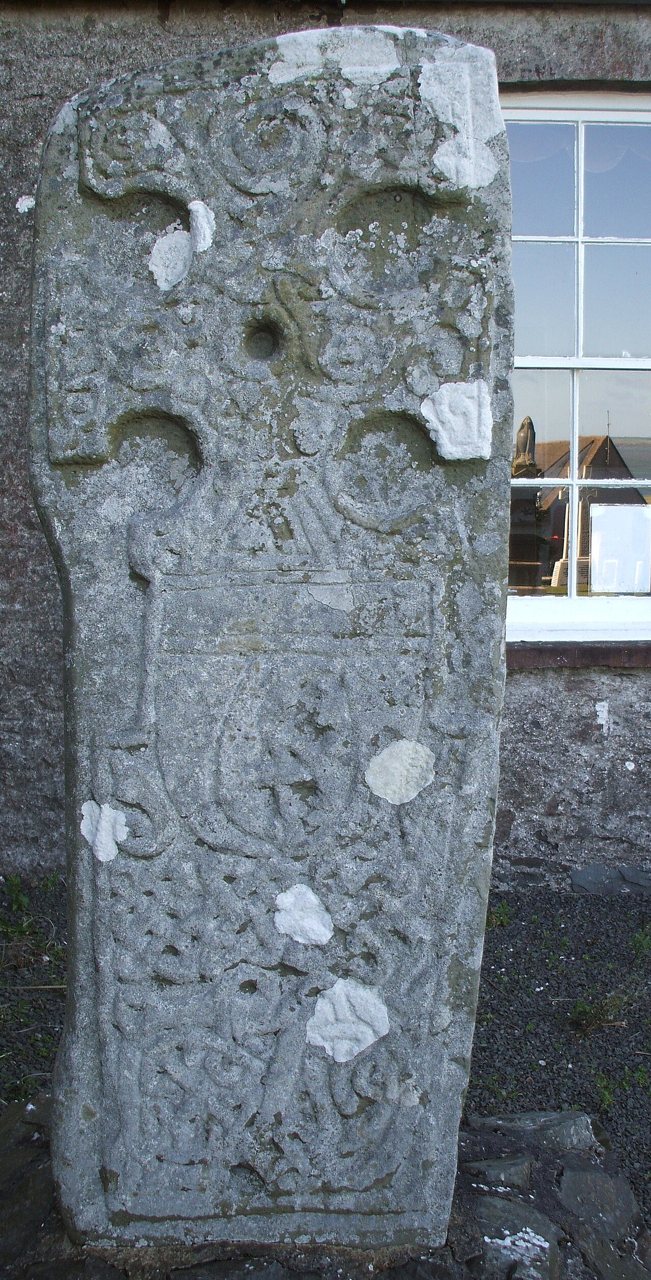
A search for Kilmorie can lead to several names and places: a former chapel, a carved cross-slab and the churchyard at Kirkcolm. The surviving stone is the clearest starting point. Understanding where it has been helps explain why the name of an early religious site now accompanies an object displayed somewhere else.
Begin with the stone's present location
Historic Environment Scotland locates the cross-slab outside Ervie-Kirkcolm Parish Church in Kirkcolm village. It is also known as the Kirkcolm, Kilmorie Chapel or Corsewall cross-slab. These names reflect different associations in its history; they do not identify three separate surviving stones.
Check the church's current visitor information before planning a stop, particularly if a service or private gathering may be taking place. Keep to appropriate access, give worshippers and mourners space, and avoid treating the churchyard as an outdoor exhibition with unrestricted movement between graves.
Follow a short sequence of recorded moves
The heritage record identifies the lost Chapel of Kilmorie as the stone's earliest known location. In 1719 it was reused as a doorway lintel at the old Kirkcolm parish church. After that church was demolished in 1821, it moved to Corsewall House's grounds. The listed church record gives 1988 for its transfer to its present setting.
Write those places beside the dates, rather than drawing a straight historical line between the current church and the early medieval carving. Reuse explains how an old object can survive within a much younger building or landscape. It also means its original surroundings cannot be reconstructed simply by looking at where it stands now.
Compare the two faces before interpreting them
HES dates the carving broadly between the eighth and tenth centuries and discusses a mixture of stylistic influences. Look for the differences between the faces and the arrangement of crosses, figures and ornament. Use the official interpretation to identify a motif instead of assuming that every worn mark is a deliberate symbol.
Descriptions connecting particular images with Scandinavian stories are interpretations of the carving. Record whose interpretation you are using and preserve any uncertainty. A visitor can appreciate the complexity of the design without treating a proposed identification as an eyewitness account of the stone's making.
Leave the surface untouched. Photographs, drawings made from a normal viewing position and published images are useful ways to compare details later. Rubbings or attempts to clean the carving can damage evidence that is already difficult to read.
A couple of practical questions
Can I visit an intact Kilmorie chapel?
The chapel associated with the stone is lost. The surviving cross-slab is in Kirkcolm churchyard, so use its current location rather than expecting a standing chapel at the original site.
Why does the stone have several different names?
It has been associated with Kilmorie Chapel, Kirkcolm and Corsewall at different times. When comparing references, check the object's description and recorded movements to establish whether the writer means the same cross-slab.

.jpg)
.jpg)