
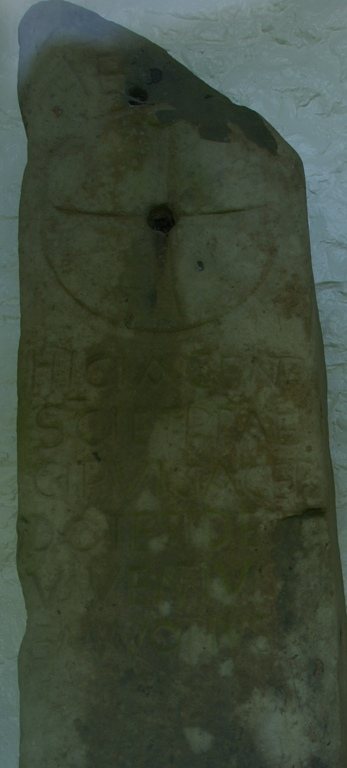
The Kirkmadrine Stones near Sandhead preserve evidence of early Christianity in southwest Scotland. Their interest lies in more than their antiquity: names, lettering and symbols offer clues about the people who commissioned them. A careful visit also separates these early memorials from the much later chapel that provides their present setting.
Put the stones on a timeline
Historic Environment Scotland identifies eight stones, including three Christian memorials dating to the sixth century. The other memorials belong to later centuries, from the eighth to the twelfth. The group therefore represents a sequence of activity rather than a set made for a single occasion.
Keep those dates beside your notes or photographs. 'Early Christian' is a useful broad description, but it can hide several hundred years of change. Comparing a lettered memorial with a later carved stone works best when you know which period each belongs to.
Look at writing as well as decoration
The heritage assessment discusses Latin writing and the Chi-Rho Christian symbol as evidence of a literate sixth-century community, probably monastic. Notice how the text is arranged and how the symbol relates to it. You do not need to translate an inscription unaided to appreciate that writing was an important part of the memorial's purpose.
Use a published explanation for the reading and meaning of worn letters. A shallow mark, damaged edge or patch of discolouration can look like part of a character in a photograph. Keep your own visual observations separate from a scholarly transcription, and record the source of any translation you note down.
Distinguish the early site from its later setting
The standing chapel should not be mistaken for an intact sixth-century church. Historic Environment Scotland distinguishes the early church site and its archaeology from the later chapel. This distinction helps you avoid assigning the age of a portable stone to every building or grave around it.
Think of the location as a place where several histories overlap. The original use of a stone, its later reuse and the way it is displayed today are separate stages. Each can affect what survives and how visitors encounter it.
Observe without touching the evidence
Check the official visitor information for the approach and any access changes. Use the designated viewing position and avoid rubbing, tracing or applying anything to the stone. If reflections make a photograph difficult, change your viewing angle within the permitted space; a published image is preferable to interfering with the display. Keep neighbouring graves and other visitors out of close-up photographs where possible.
A couple of practical questions
Are all eight stones the same age?
No. The three earliest memorials date to the sixth century, while the rest belong to later periods. Use the official interpretation to identify individual stones and their chronology.
Is the chapel itself an early Christian building?
The standing chapel is later than the earliest stones. The early Christian significance concerns the memorials and the underlying church site, so keep the dates of those elements separate.

.jpg)
.jpg)